
The Night Before the Palio
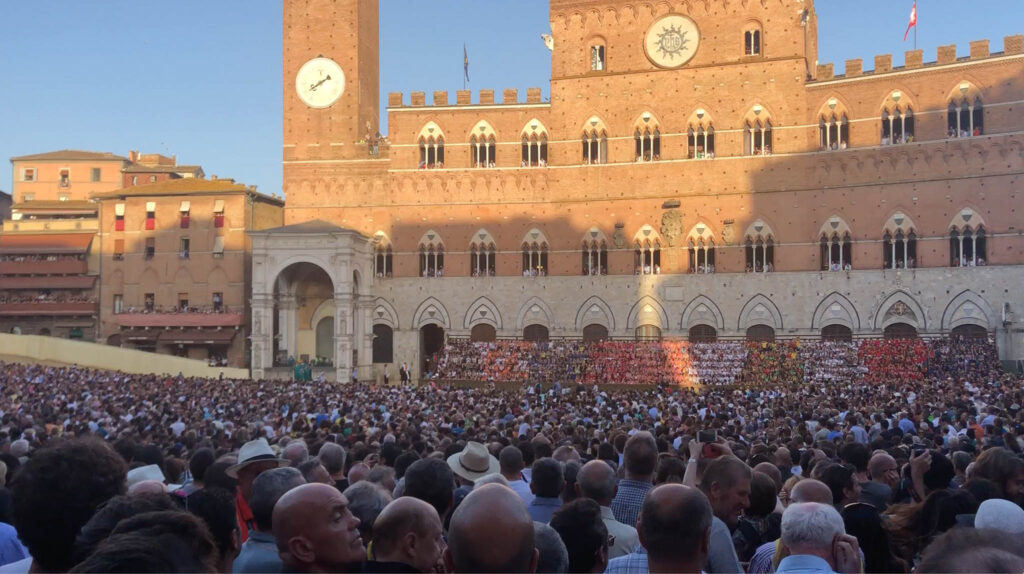
Italy has a way of making everything you read about it feel like an understatement.
I had read about the Palio di Siena — the ancient horse race that tears through the Piazza del Campo twice a year on July 2nd and August 16th, horses and bareback riders flying around a medieval square packed with fifty thousand people, the whole city organized around seventeen neighborhood factions called contrade, each with its own colors, its own symbol, its own centuries-long grudges. It dates to 1633 in its current form, though Siena was staging versions of it long before that. People have been losing their minds over this race for four hundred years.
I also knew there were contrada dinners the night before — private affairs, each neighborhood hosting its own, somewhere in the winding streets of Siena. And I knew that if you tracked down the right email address for the right contrada and fired off a message into the void, you might get an invitation.
So I did. And we waited.
Ironically, the snail wrote back first.
Chiocciola. One of Siena’s seventeen contrade, ancient enough to have a sworn enemy — the Tartuca, the tortoise — and a rivalry that predates most countries. What I didn’t fully appreciate until later was just how seriously the Sienese take all of it. Each contrada’s horse is assigned by lottery just days before the race, then essentially adopted by the neighborhood — stabled inside its streets, groomed, fussed over.. Before the race, the horse is led into the contrada’s church to be blessed. “Go and return victorious,” says the priest. It is considered good luck if the horse leaves droppings in the church. The Sienese are nothing if not practical about miracles. The jockeys, meanwhile, operate in a world of open secrets: hired guns who are paid by their contrada and known to accept funds from rivals to sabotage their enemies mid-race. This is not scandal. This is strategy. It has always been this way. The contrada that has gone the longest without a victory earns the nickname la nonna — the grandmother — and carries that distinction until someone finally puts them out of their misery. The prize for winning is not money. It’s a painted silk banner called the drappellone — or, with great Sienese affection, il cencio. The rag. Centuries of pride, for a rag.
We were Chiocciola now.
We almost didn’t go to the dinner. By that point in the trip, Eric, our son Jake, and I were tired in the good, full way that happens when you’ve been moving hard through a place you love. We didn’t really know what we were walking into. Our expectations, I’ll be honest, were modest.
Then we turned the corner.
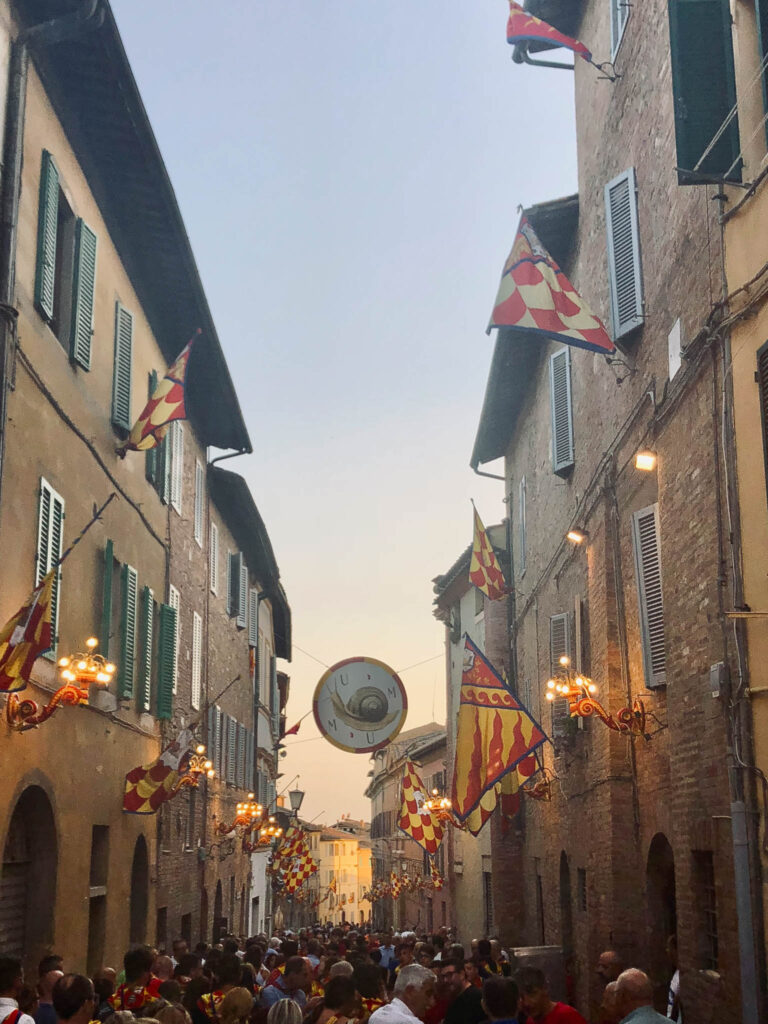
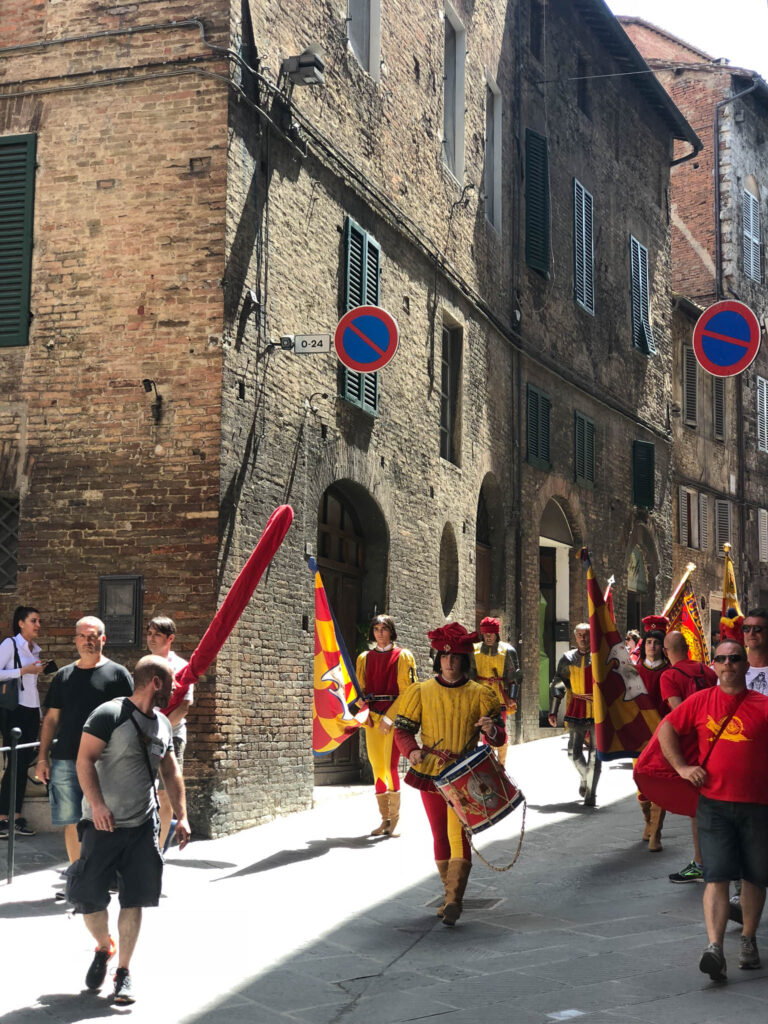
About a thousand people lined the streets at long tables. The neighborhood had transformed itself — not for tourists but for themselves, the way they had done this every single year for centuries. The jockey paraded through the table-lined cobblestone street on horseback and the crowd erupted like he was a returning hero, because to them, he was. Young men marched the streets all night with drums, enormous flags spinning overhead, the drumbeats bouncing off stone walls that have been standing since the Middle Ages. The nonnas kept bringing food — more courses than we expected, more than we could finish, more of everything. We sat at a long table and watched it all unfold around us — unbothered observers let in on something we hadn’t earned with generations of tradition like everyone else there. We didn’t belong. We were allowed. There is a difference, and it made the whole evening feel like a gift.
Total outsiders. Completely, improbably inside something real.
The next day was the race itself. If you’ve never stood in the Piazza del Campo for the Palio, here is what nobody tells you: the waiting is its own event. We arrived hours early to get a good position at the top of the slope of the piazza, near the starting and finish line. The horses take close to an hour just to line up — jostling, the jockeys watching each other like poker players who already know what cards are on the table. Around us, passionate young Italians argued and shoved, cigarette smoke drifted through the heat. The tension winds up slowly and doesn’t let go. One practical note: fifty thousand people, one piazza, bathrooms many streets and many people away. Plan accordingly. Choose your beverages wisely.
When it finally starts, the race itself lasts about ninety seconds. Three laps around the piazza, and the first horse across the finish line wins — even if it’s running without its rider. That happens more than you’d think. The corners are treacherous, jockeys are permitted to push, shove, and interfere with each other, and sometimes a horse simply outruns everyone on its own terms. In Siena, that’s not a technicality. That’s a win. And when a contrada’s great rival loses, that neighborhood celebrates nearly as joyfully as if they’d won themselves. There are old scores being settled everywhere you look. And for us, standing in that square, it was the opposite of every tourist-facing version of Italy we’d encountered — the tchotchke-lined streets, the queues for the famous views, the experiences designed to be consumed and forgotten. This was Siena doing something entirely for itself, and we happened to be standing in it.
I didn’t engineer any of this day. I just sent the emails. I stayed curious. I asked one more question than most people bother to ask.
That’s usually all it takes.
The Palio runs July 2nd and August 16th each year. The contrada dinners are the night before. If you want to go, start the conversation early. Some contradas are more open to visitors than others, and it takes patience and a willingness to follow up. We happen to know which ones write back.


